Die EU-Kommission sieht die EU als Vorreiterin bei der Umsetzung der Agenda 2030 und nimmt in einem Reflexionspapier vor allem andere Staaten in die Pflicht. Hier knüpft die Kritik von zivilgesellschaftlichen Organisationen an: Nach Verabschiedung der Agenda 2030 und der SDGs im Jahr 2015 habe die EU weder mit der konsequenten Umsetzung der SDGs auf EU-Ebene begonnen noch eine eigene Nachhaltigkeitsstrategie entwickelt. Stattdessen trete die Kommission auf der Stelle, indem sie auch vier Jahre nach Verabschiedung der SDGs noch immer [...]
Publikationen
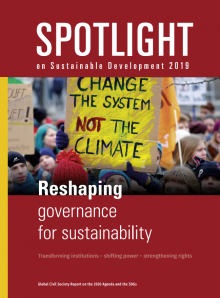
Spotlight on Sustainable Development 2019
Transforming institutions – shifting power – strengthening rights
Four years after the adoption of the 2030 Agenda the world is off-track to achieve the Sustainable Development Goals (SDGs). Most governments have failed to turn the transformational vision of the 2030 Agenda into real transformational policies. Even worse, xenophobia and authoritarianism are on the rise in a growing number of countries.
But there are signs of change. Social movements have emerged worldwide, many with young people and women in the lead [...]
Spotlight Report on Sustainability in Europe
Studying EU policies thoroughly means studying policies of externalization. The thirteen chapters assembled in this publication constitute an impressive – impressively gloomy though – evidence for this assertion. Wherever you turn your eyes, whatever policy domain you may be concerned with: What at first glance may seem to be part of the European Union’s internal policies immediately turns out to be a story of externalities, a matter of spill-over effects transcending the borders of the European polity. And more often [...]
Berlin/ New York, 09. Juli 2019 – Anlässlich des heute beginnen High-Level Political Forum for Sustainable Development (HLPF) werden 47 Länder über die Umsetzung der Ziele für nachhaltige Entwicklung (SDG) in ihren jeweiligen Ländern berichten. Marie-Luise Abshagen, Referentin für Nachhaltige Entwicklung im Forum Umwelt & Entwicklung, wird vom 12. bis 18. Juli vor Ort sein, blickt dem HLPF allerdings kritisch entgegen.

Global civil society report assesses structural obstacles and institutional gaps in the implementation of the 2030 Agenda
New York, 8 July 2019: “The world is off-track to achieve the Sustainable Development Goals (SDGs). Most governments have failed to turn the transformational vision of the 2030 Agenda into real transformational policies. Even worse, xenophobia and authoritarianism are on the rise in a growing number of countries.”
“The implementation of the 2030 Agenda is not just a matter of better policies. It requires more holistic and more sweeping shifts in how power is vested, including through institutional and governance [...]

Die ambivalente Rolle der Wirtschaft bei der Umsetzung der SDGs
Immer mehr Unternehmen setzen sich öffentlich für die Umsetzung der Agenda 2030 ein und beziehen sich in ihren Nachhaltigkeitsberichten auf die Ziele für nachhaltige Entwicklung (SDGs). Ihre Unternehmenspraxis sieht jedoch oft anders aus: Immer wieder klagen Betroffene über Menschenrechtsverletzungen und Umweltverschmutzung entlang der Lieferkette transnationaler Unternehmen. Der Umsetzungsprozess der Agenda 2030 wird von einer wachsenden Zahl von Wirtschaftsakteuren als willkommene Gelegenheit gesehen, dieser Kritik zu begegnen, den Diskurs in ihrem Sinne zu gestalten und politische Entscheidungen entsprechend zu beeinflussen.
Das [...]
Reformoptionen und -notwendigkeiten
Das High-level Political Forum on Sustainable Development (HLPF) hat sich in den ersten drei Jahren nach Verabschiedung der Agenda 2030 und ihrer Ziele (SDGs) zweifellos als das Forum zur Diskussion von Fragen nachhaltiger Entwicklung etabliert. Die Frage ist allerdings, ob dieser Erfolg der Veranstaltung an sich bedeutet, dass auch die Umsetzung der Agenda 2030 auf einem guten Weg ist, bzw. welchen tatsächlichen Beitrag das HLPF dazu leistet. Derzeit werden diverse Vorschläge diskutiert, wie das HLPF als einer der zentralen Bausteine [...]
Reformvorschläge für das High-level Political Forum on Sustainable Development
Das High-Level Political Forum on Sustainable Development (HLPF), das zentrale Gremium der Vereinten Nationen (UN) im Umsetzungsprozess der Agenda 2030 und ihrer Ziele für nachhaltige Entwicklung (SDGs), hat sich drei Jahren nach Verabschiedung der Agenda zweifellos als das globale Forum zur Diskussion von Fragen nachhaltiger Entwicklung etabliert.
Mehr als 2.000 Teilnehmer*innen haben es 2018 besucht, darunter mehr als 120 hochrangige Regierungsvertreter*innen. Immer mehr Länder stellen ihre Umsetzungsbemühungen im Rahmen freiwilliger Staatenberichte vor. Die Zahl der Veranstaltungen im Rahmenprogramm sprengen längst [...]
Ansätze für eine bessere Verzahnung von HLPF und FfD-Forum
Ohne die in der sog. Aktionsagenda von Addis Abeba (AAAA) vereinbarten Umsetzungsmittel (means of implementation) werden die SDGs kaum zu erreichen sein. Das spiegelt sich allerdings weder in effektiven politischen Beschlüssen noch in einer engen Verzahnung der Überprüfungsprozesse von Agenda 2030 und AAAA wider. Für die Überprüfung und Weiterentwicklung der FfD-Beschlüsse ist ein separates Gremium der UN zuständig, das sog. FfD Forum. Seine Diskussionen und Empfehlungen werden beim HLPF lediglich zur Kenntnis genommen. Das liegt unter anderem an der unterschiedlichen [...]
Indikatoren für die Agenda 2030
Eine wesentliche Grundlage für einen effektiven Überprüfungsmechanismus für die Agenda 2030 und ihre Ziele für nachhaltige Entwicklung (SDGs) sind die Indikatoren, mit denen die Verwirklichung der Zielvorgaben gemessen wird. Die Regierungen hatten dieses Thema aus den Verhandlungen über die Agenda 2030 weitgehend ausgeklammert, weil sie das Aushandeln einzelner Indikatoren auf politischer Ebene als kaum machbar ansahen. Stattdessen erteilten sie der Statistikkommission der UN das Mandat, ein Set von SDG-Indikatoren vorzulegen. Bei ihrer Tagung im März 2017 einigte sich die Kommission [...]