
Februar 2016

By Sarah Dayringer

On 8-11 March 2016, the 47th Session of the United Nations Statistical Commission will be held at the UN Headquarters in New York. A major item on their agenda will be the consideration of the global SDGs indicator framework, by which to measure progress on achieving the 169 far-reaching SDGs targets generated by the Interagency and Expert Group on SDGs (IAEG-SDGs). After several rounds of consultation led by IAEG-SDGs co-chairs Enrique Ordaz (Mexico) and Lisa Bersales (Philippines), 231 [...]
Following a participative and comprehensive process over several years, in September 2015 the United Nations (UN) adopted the global Sustainable Development Goals (SDGs). The SDGs must now be implemented in and by Germany. It is our opinion that in order to do so, fundamentally different approaches must be taken in areas of political action. Germany must accept its responsibility for sustainable development and implement the 2030 Agenda in accordance with its five principles (people, planet, prosperity, peace, partnership). „Leave no [...]

Nach jahrelangen internationalen Verhandlungen verabschiedeten die Vereinten Nationen Ende September 2015 die sogenannte 2030-Agenda. Ihr Herzstück sind 17 Ziele für nachhaltige Entwicklung (Sustainable Development Goals, SDGs), die bis 2030 von allen Staaten umgesetzt werden sollen. Sie folgen auf die Millenniumentwicklungsziele (Millennium Development Goals, MDGs). Die neuen nachhaltigen Entwicklungsziele gehen wesentlich weiter als ihre Vorläufer: Sie verbinden soziale, ökologische und ökonomische Nachhaltigkeit und fordern Frieden, Rechtsstaatlichkeit und eine unabhängige Justiz ein. Außerdem gelten sie universell und somit für Industrieländer, Schwellenländer und [...]

Die Vereinten Nationen (UN) haben nach einem mehrjährigen, partizipativen und umfassenden Prozess im September 2015 globale Ziele für Nachhaltige Entwicklung (SDG – Sustainable Development Goals) beschlossen. Die SDG gilt es nun auch in und durch Deutschland umzusetzen. Aus unserer Sicht brauchen wir dafür in zentralen politischen Handlungsfeldern grundlegend andere Weichenstellungen als bisher. Deutschland muss sich seiner Verantwortung für nachhaltige Entwicklung stellen und die 2030-Agenda im Sinne ihrer fünf Prinzipien (Menschen, Planet, Wohlstand, Frieden, Partnerschaft) umsetzen.

Mit diesem Positionspapier beziehen deutsche [...]

Am 25. September 2015 verabschiedeten die 193 Mitgliedsstaaten der Vereinten Nationen auf einem Gipfeltreffen in New York die 2030-Agenda für nachhaltige Entwicklung. Sie bildet den globalen Rahmen für die Umwelt- und Entwicklungspolitik der kommenden 15 Jahre. Kernstück der Agenda sind die 17 Ziele für nachhaltige Entwicklung, die SDGs, mit ihren 169 Zielvorgaben. Sie berühren alle Politikbereiche, von der Wirtschafts-, Sozial-, Umwelt- und Finanzpolitik über die Agrar- und Verbraucherpolitik bis hin zu Bereichen wie Verkehr, Städtebau, Bildung und Gesundheit.

Die Umsetzung [...]

One of the concrete commitments from the Addis Ababa Action Agreement and the 2030 Agenda for Sustainable Development (2030 ASD) is the Technology Facilitation Mechanism (TFM). Spearheaded by Brazil and France, the development of the TFM has been described by Sérgio Rodrigues dos Santos of Brazil, as a “testimony to the strength of multilateralism through collective action.”

Expectations are high for TFM in a briefing on its progress, the President of the UN General Assembly lauded the TFM launched in [...]

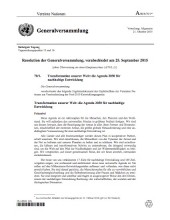
Wenige Monate nach Verabschiedung der 2030-Agenda für nachhaltige Entwicklung hat der deutsche Übersetzungsdienst für die Vereinten Nationen diese für die kommenden 15 Jahre wichtige Dokument nun auch in einer offiziellen Übersetzung vorgelegt.

The United Nations has offered its annual assessment of prospects for 2016 in its World Economic Situation and Prospects (WESP) report. It opened with: “The world economy stumbled in 2015, amid weak aggregate demand, falling commodity prices and increasing financial market volatility in major economies.” In addressing the impact of the downward pressure on economies, UN ASG Lenni Montiel, explained that many countries, “specifically LDCs which rely on commodity exports, will be unable to sustain public spending on [...]